





Siemens: Middle East Leads Global Infrastructure Transition as AI, Resilience and Grid Modernization Accelerate


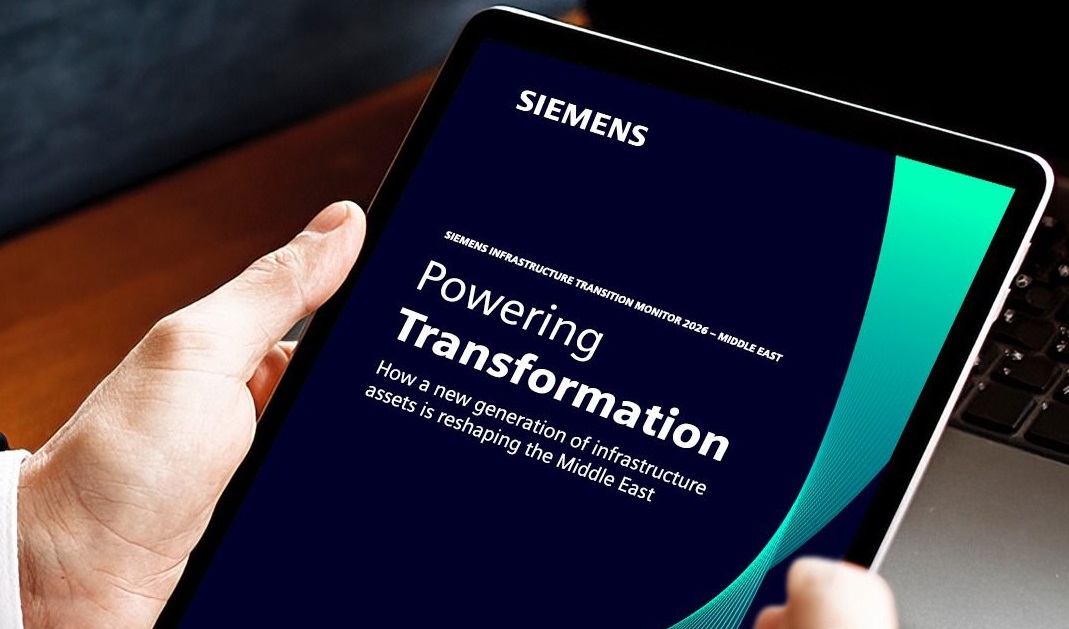
A new study from Siemens reveals the Middle East is ready to enter a new era of infrastructure transition that is autonomous, resilient, and sustainable. According to the 2026 Middle East Infrastructure Transition Monitor, the region is outpacing global counterparts in its commitment to the transition, with regional leaders demonstrating stronger investment intentions and a heightened sense of urgency around clean energy transformation.

Siemens’ comprehensive study, titled Powering Transformation: How a new generation of infrastructure assets is reshaping the Middle East, based on a survey of 400 senior executives and in-depth interviews with leaders and experts in the region, reveals a region aligned for impact, with 66% of executives stating that the global energy transition needs to accelerate significantly, compared with 57% globally. The combination of optimism and urgency reflects a region at an inflection point, where governments have set ambitious strategic priorities, prompting organizations to follow suit.
“The 2026 Middle East Infrastructure Transition Monitor highlights a significant shift across the Middle East, as infrastructure evolves into a strategic driver of competitiveness, resilience, and sustainable growth,” said Hakan Ozdemir, CEO of Siemens Smart Infrastructure in the Middle East and Siemens Qatar. “As energy systems grow more complex and demand continues to rise, success will depend on the ability to connect data, intelligence, and physical infrastructure at scale. At Siemens, we see this transformation unfolding every day. By bridging the real and digital worlds, we are helping customers move beyond traditional infrastructure toward industrial AI-enabled systems that not only power autonomous buildings and future grids efficiently but also make them resilient. The next phase of infrastructure transformation will be defined by how intelligently systems can anticipate, adapt, and respond to change.”

The autonomous future is here
Industrial AI is accelerating operational transformation, unlocking unprecedented efficiency, productivity, and sustainability across national systems. 62% of executives expect AI to reshape infrastructure operations within just three years. Readiness to embrace automation is equally notable, with 56% of organizations prepared to implement autonomous systems in buildings, and 57% planning significant investments in this area over the coming year.
The demand for smarter technologies is equally as prevalent, with 69% of respondents indicating that their organizations require more sophisticated solutions to enable rapid data integration, a necessity for overcoming institutional barriers and legacy system challenges. This recognition is translating into investment commitments, with the same percentage planning to increase spending on data integration technologies.
Resilience is the new efficiency
The continuously evolving regional landscape has created a need for infrastructure systems that can anticipate failures, isolate issues, and learn from every disruption. Already, 61% of organizations confirm that industrial AI is making their critical infrastructure more resilient, underscoring the technology’s immediate practical applications.
Grid modernization remains central to both clean energy transition and overall resilience, with 64% identifying smart grids and grid software as crucial enablers and 66% supporting the integration of various parts of the energy system, such as electricity, gas, hydrogen, and transportation, into a single, coordinated platform. The region is also proactively investing in cross-border interconnections and regional power-trading arrangements, essential steps toward ensuring a reliable, resilient electricity supply and strengthening response capabilities during outages or extreme weather events.
Sustainability by design
The Middle East’s infrastructure transition is grounded in sustainability by design, with decarbonization as a regional priority and AI-enabled hardware and software embedded directly in the core of infrastructure rather than added as afterthoughts.
Decarbonizing core operations has emerged as the leading priority for the region’s organizations, with 70% already setting targets for direct and indirect emissions, compared with 58% globally. Digitalization is recognized as the critical driver for this transformation, with 68% considering digitalization an essential enabler.
Collaboration is also emerging as a cornerstone of the region’s transition, with 65% confirming that businesses and governments are working closely on energy-system policy, surpassing the global average of 59%.
The Siemens 2026 Middle East Infrastructure Transition Monitor reinforces the Middle East’s position as a region where ambition meets execution, with organizations demonstrating not only awareness of the transition imperative but also the collaborative frameworks and investment commitments necessary to turn ambition into lasting impact. As infrastructure systems become increasingly interconnected, resilience, digital intelligence, and adaptability will be critical to sustaining long-term growth and competitiveness.

